

UltraClear® Laser Resurfacing
- What Is UltraClear Laser Resurfacing?
- What Is Laser-Coring, and Why Does It Matter?
- What Skin Concerns Can UltraClear Treat?
- Am I a Good Candidate for UltraClear Laser Resurfacing?
- What Are the Risks of UltraClear Laser Resurfacing?
- When Is Surgery the Better Answer?
- How Do I Prepare for UltraClear Laser Resurfacing?
- What Happens During and After Treatment?
- When Will I See Results?
- Why Choose 740 Park Plastic Surgery for UltraClear Laser Resurfacing?
- What Do Patients Say?
- What Else Do Patients Ask About UltraClear?
UltraClear laser resurfacing is a fractional laser treatment that removes microscopic columns of damaged skin to prompt the body to build new collagen. Because the treatment depth is adjustable, one platform can deliver anything from a light surface refresh to deeper correction of etched lines, scars, and rough texture.
Fine lines, sun damage, and uneven texture do not always call for surgery, but they deserve more than a generic laser package. Patients throughout NYC, Manhattan, and New York City come to 740 Park Plastic Surgery for skin treatments that hold up to close inspection, and UltraClear, under the oversight of Dr. Stafford Broumand, has become part of how we address tone, texture, and early laxity without an operation. What distinguishes this treatment at a surgical practice is context: our practice evaluates skin quality alongside facial structure, so the recommendation you receive reflects what resurfacing can genuinely accomplish for your face, not simply what the device is capable of doing.
What Is UltraClear Laser Resurfacing?
UltraClear is a fractional laser that treats skin in narrow columns rather than removing the entire surface at once. The untreated skin between those columns speeds healing, which is why recovery is measured in days rather than weeks.
Because water in the skin absorbs the laser’s energy so efficiently, most of that energy goes toward removing the targeted tissue rather than spreading out as heat. That is why the platform is often described as a cold laser: less heat means less discomfort and a shorter recovery than patients typically expect from this kind of treatment.
As the skin heals, the body lays down fresh collagen and elastin, and the surface regenerates with more even tone and smoother texture. Both the depth and density of treatment are adjustable, so a patient addressing early sun damage and a patient addressing etched lines can be treated on the same device with entirely different settings and entirely different recovery expectations.
- What Is UltraClear Laser Resurfacing?
- What Is Laser-Coring, and Why Does It Matter?
- What Skin Concerns Can UltraClear Treat?
- Am I a Good Candidate for UltraClear Laser Resurfacing?
- What Are the Risks of UltraClear Laser Resurfacing?
- When Is Surgery the Better Answer?
- How Do I Prepare for UltraClear Laser Resurfacing?
- What Happens During and After Treatment?
- When Will I See Results?
- Why Choose 740 Park Plastic Surgery for UltraClear Laser Resurfacing?
- What Do Patients Say?
- What Else Do Patients Ask About UltraClear?
What Is Laser-Coring, and Why Does It Matter?
Laser-Coring™ is UltraClear’s deepest mode, and it works differently from conventional resurfacing. Rather than removing surface tissue, it removes narrow, full-thickness cores of skin that close as the surrounding tissue contracts. According to the device manufacturer, Laser-Coring combines tissue coring with laser rejuvenation to tighten skin while limiting heat buildup, and we use it most often along the jawline, jowls, and neck.
This is the mode that draws the most questions at a plastic surgery practice, and it deserves a straight answer. Laser-Coring can meaningfully improve crepey texture and mild to moderate looseness. It does not reposition deeper tissue, and it does not remove excess skin. Understanding that boundary before you commit is the difference between a satisfying result and a disappointing one.

What Skin Concerns Can UltraClear Treat?
- Fine lines and etched wrinkles, including lines around the mouth and eyes
- Sun damage, brown spots, and uneven pigmentation
- Acne scars and surgical or traumatic scars
- Rough texture, dullness, and enlarged pores
- Crepey skin and mild laxity along the jawline and neck
Am I a Good Candidate for UltraClear Laser Resurfacing?
Good candidates are in reasonable health, are bothered by skin quality rather than facial sagging, and can accommodate the recovery that matches the depth of treatment they need.
Skin tone is less limiting with this platform than with older ablative lasers, since it responds to water in the skin instead of pigment. Settings are still adjusted for your skin type, and pretreatment preparation may be recommended.
UltraClear is generally deferred, or requires additional planning, for patients who are pregnant, have an active skin infection or inflammatory condition in the treatment area, have taken isotretinoin recently, or have a history of keloid formation. Patients with a history of cold sores may be prescribed a preventive antiviral, and a recent tan is also a reason to wait. We screen for these factors during your evaluation.
What Are the Risks of UltraClear Laser Resurfacing?
No resurfacing laser is risk-free, and UltraClear is no exception. Post-inflammatory hyperpigmentation, a temporary darkening of the treated skin, is a well-documented risk after this kind of injury in skin of color, based on research on skin of color. That is why prevention is treated as a genuine clinical consideration here, not an afterthought, and why your consultation includes an honest look at your skin’s healing tendencies before we recommend a plan.
When Is Surgery the Better Answer?
This is where a plastic surgery practice can tell you something a device-only clinic cannot.
Resurfacing improves the quality of the skin envelope. It does not address descent of the deeper facial tissues, excess skin along the jawline and neck, or the loss of underlying support that produces jowling. If the concern you see in the mirror is texture, tone, fine lines, and scars, UltraClear is well matched to it. If the concern is contour, a laser will refine your skin without changing the shape of your face, and you may leave the series feeling that something was missed.
For patients whose evaluation points toward structural change, Dr. Broumand can discuss facelift surgery and other surgical options directly. Many patients ultimately combine the two, using surgery to restore position and resurfacing to restore skin quality, since one cannot substitute for the other. Others are best served by a non-surgical plan built around UltraClear alongside Morpheus8® or SkinPen® microneedling.
How Do I Prepare for UltraClear Laser Resurfacing?
Preparation matters more here than for most non-surgical treatments, since the laser responds to the exact condition of your skin on the day of your appointment. Stay out of the sun and off tanning beds for at least 2 weeks beforehand. Tanned or recently sun-exposed skin absorbs the laser differently and raises your risk of uneven results.
Bring a full list of what you take, including retinoids, exfoliating acids, and blood thinners, to your consultation. We may ask you to pause certain products beforehand. A history of cold sores is worth mentioning too, since a preventive antiviral can head off a breakout during healing.
If you are planning Laser-Coring or a deeper setting, build your calendar around a real recovery window rather than squeezing it in before something important.
What Happens During and After Treatment?
Treatment begins with cleansing and, for anything beyond the lightest settings, a topical anesthetic. The handpiece is then passed across the treatment area in a measured pattern. Most patients describe warmth and a light prickling sensation. In a full-face resurfacing study, patients rated average pain during treatment at 4.9 out of 10 using topical anesthesia alone.
How much you notice afterward depends on the depth you and your provider choose. A light setting leaves you with redness similar to a mild sunburn for a day or two, with some fine flaking. Deeper settings bring more visible redness, swelling, pinpoint bleeding, and crusting. In that same study, these post-treatment skin responses resolved over 5 to 7 days, with no cases of infection, scarring, or hypopigmentation reported.
Aftercare is straightforward and matters more than patients expect. Gentle cleansing, consistent moisturizing, no picking, and disciplined sun protection are the entire protocol. We provide written instructions and remain available throughout healing.
When Will I See Results?
Surface brightness and smoother texture appear first, usually within 1 to 2 weeks as your skin finishes healing. Collagen rebuilding takes longer. In a full-face resurfacing study, patients assessed 90 days after their third session rated their satisfaction at an average of 4.8 out of 5.
Most patients are advised to plan for a short series rather than a single session, spaced several weeks apart, with maintenance thereafter. Results vary from patient to patient, and your treatment plan will be set at consultation.
Why Choose 740 Park Plastic Surgery for UltraClear Laser Resurfacing?
Excellence meets artistry in the heart of New York City, and that standard applies to a single laser session as much as it does to an operation.
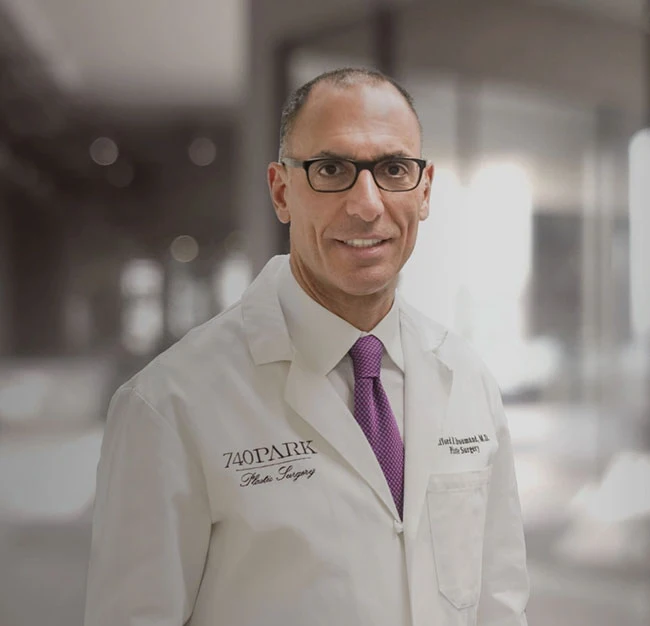
UltraClear treatments at our practice are delivered under the oversight of Dr. Broumand, who brings a surgeon’s understanding of facial anatomy to every non-surgical plan. Device settings are selected for your skin type, your concern, and the recovery window you can realistically accommodate, not applied from a standard protocol.
Because we are a surgical practice first, we know exactly where a laser stops being the right answer, and we will tell you so rather than keep you on a resurfacing plan that will not get you where you want to go. Our surgical suite is AAAASF certified, the highest level of accreditation, and that same standard of safety carries over into every non-surgical treatment we perform.
Our philosophy is to reveal the best version of you rather than to sell a transformation, and that begins with recommending only what will actually work.
What Do Patients Say?
“The absolute best of the best. If you know, you know. This office is discreet, talented, knowledgeable, caring, clean, beautiful, and wonderfully staffed. Working with them is a privilege in my book!”
– Elizabeth S.
Google Review
⭐⭐⭐⭐⭐
“The office is beautiful, the team is wonderful, and Dr. Broumand is incredible. First class treatment and very caring individuals.”
– Lew4Kids
Google Review
⭐⭐⭐⭐⭐
How is pricing for UltraClear laser resurfacing determined?
There is no menu price for UltraClear, since your plan depends entirely on the mode, the areas involved, and how many sessions get you where you want to be. We quote it after your evaluation. UltraClear is an aesthetic treatment and is not covered by insurance. We also offer financing options for patients who prefer to spread out the investment. Consultations at our practice are paid.
How long does an UltraClear session take?
A superficial full-face treatment can be completed in roughly 10 to 15 minutes, while deeper resurfacing and Laser-Coring sessions take longer depending on the areas treated. Allow additional time beforehand if a topical anesthetic is applied.
How is UltraClear different from a CO2 laser?
Both remove tissue, but UltraClear’s wavelength is absorbed by water far more efficiently, so less energy disperses as heat into the surrounding skin. The practical differences patients notice are less discomfort during treatment and a shorter recovery, particularly at lighter settings.
Can UltraClear be combined with other treatments?
Yes, and it frequently is. We typically sequence UltraClear with Botox® Cosmetic, dermal fillers, or AquaGold® Fine Touch once your skin has fully healed, rather than treating on the same day, so we can assess your results on settled skin. As noted above, some patients pair UltraClear with Morpheus8® or SkinPen® microneedling as part of a broader non-surgical plan. Timing for any combination is set at your consultation.
How often will I need maintenance treatments?
Most patients return for a light maintenance session once or twice a year after completing their initial series, while deeper corrective treatments are repeated far less frequently. Your interval depends on your skin, your sun exposure, and your home care.
Ready to Schedule Your Consultation?
If you are considering UltraClear laser resurfacing in NYC, the most useful next step is an evaluation that looks at your skin and your facial structure together. Patients throughout Manhattan and greater New York City choose our practice for discreet, precise aesthetic care and for guidance they can trust, including honest direction when a different treatment would serve them better.
Schedule a consultation and we will map out whether UltraClear, a different treatment, or a combination gets you where you want to be.
Murray TN, Hu JK, Friedman PM. Full-face and neck resurfacing with a novel ablative fractional 2910 nm erbium-doped fluoride glass fiber laser for advanced photoaging. Lasers Surg Med. 2024;56(3):249-256. https://doi.org/10.1002/lsm.23764
Ho SGY, Chan HHL. The Asian dermatologic patient: review of common pigmentary disorders and cutaneous diseases. Am J Clin Dermatol. 2009;10(3):153-168. https://doi.org/10.2165/00128071-200910030-00002
Acclaro Medical. Laser-Coring Treatment. https://ultraclearlaser.com/treatment/laser-coring/
Dr. Stafford Broumand has reviewed and approved this content.
Page Updated: